
Naperville Address History Sources
No single roll identifies every past occupant. The best source depends on the period and on whether the question concerns an owner, subscriber, taxpayer, or full household. DuPage and Will recorder books form the ownership spine. Printed and digitized directories add dated names. Census schedules supply a household snapshot, while maps and permits explain what stood on the parcel at the time.
| Source | Years it covers | Where held | What it shows |
|---|---|---|---|
| DuPage recorder index and images | Office records from 1839; online name from 1961, PIN from 1985, address from 1995 | Recorder portal and Wheaton research desk | Recorded parties, instrument, date, document number, and legal description |
| Will recorder records | Books from 1836; online documents generally from 1965 | Direct Search and Joliet archive | Deeds, plats, liens, recording parties, and dates |
| Local directory runs | 1886; 1927-28; 1983 and 1985-current in the dated inventory | Naperville library and local collections | Name or address entries, with content varying by publisher |
| Telephone books | Most years 1909-1960 in the Heritage Collection; other listed local runs | Illinois Digital Archives and library | Subscriber, address, telephone, and some work or business notes |
| Federal census | Public schedules through 1950 | NARA and library databases | Household on the enumeration date, age, relationship, birthplace, and work |
| Sanborn maps | Local years include 1886, 1892, 1898, 1909, 1921, and 1926-49 | Library of Congress and local microfilm | Building footprint, use, material, and lot context, but not occupant names |
Start with the newest reliable parcel identity. Move to the closest dated source for the period in question. A modern address alone is weak when a parcel was split, a street label changed, or a directory used a township name. The PIN and legal description keep the backward trail tied to the same land.
Two Naperville Deed Timelines
Naperville crosses the DuPage-Will line near 87th Street. Confirm the county before opening an index. The DuPage County Recorder holds property records from 1839, but its online windows begin at different dates for names, PINs, and addresses. The Will County Recorder traces its repository to 1836, with online real-estate documents generally beginning in 1965 and older books at the Joliet archive.
The split changes the fallback route. An early DuPage instrument may require the Wheaton research desk, older deed books, a document number, or a legal description. Will researchers can use archive workstations and microfilm in Joliet. Call ahead to check an old volume, image access, copy method, and accepted search key. An online miss is not proof that no transfer exists.
The manifest image below comes from the official DuPage recorder route. It shows why the index belongs near the start of a Naperville previous residents search.
Open the DuPage Recorder historic index before comparing its fields with the parcel card.
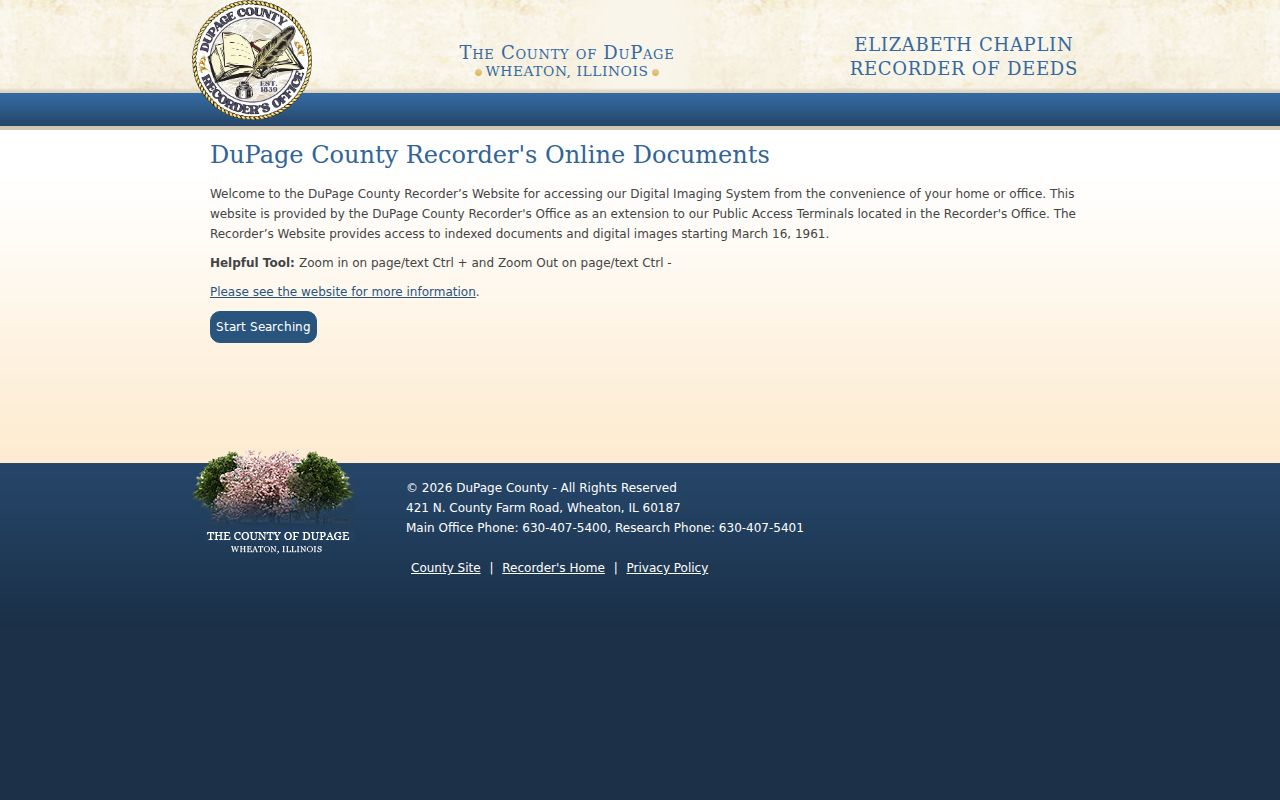
The screen is an index route, not a finding that a recorded party occupied the house. Save the document number and inspect the legal description.
Note: Naperville's county line makes the correct recorder and archive more important than a broad surname search.
Trace Naperville Past Owners
A chain of title is the ordered series of recorded transfers for one parcel. Work backward from the current assessor entry. Do not jump from one matching surname to another. Trusts, companies, estates, parcel splits, and transfer-on-death instruments can interrupt a simple sequence, so the legal description and recorded document number must control each step.
- Find the current PIN, situs address, legal description, and tax-roll owner in the correct county assessor portal. Keep the billing address separate from the property address.
- Search the recorder for the present owner's purchase deed. Record the grantor, grantee, date, document number, subdivision, lot or block, and PIN reference.
- Search the seller as an earlier grantee. Confirm that the next instrument describes the same parcel before adding it to the sequence.
- Repeat the search through trusts, estate transfers, liens, releases, plats, and parcel changes. Use the assessor transfer history as a cross-check.
- At the online cutoff, contact the Wheaton or Joliet office for books, microfilm, plats, workstations, copies, or research help.
- Grantor
- The party transferring an interest in a recorded instrument.
- Grantee
- The party receiving that interest.
- Chain of title
- The linked series of recorded transfers for the same land.
- Legal description
- The lot, block, subdivision, condominium, or boundary wording that identifies land more reliably than an old street number.
The Will Recorder search guide treats Name, PIN, and Address as separate modes. Its instructions also explain that dropping four trailing zeros from a complete PIN can broaden a search. That method helps when a strict entry misses an instrument, but every broader hit still needs a legal-description check.
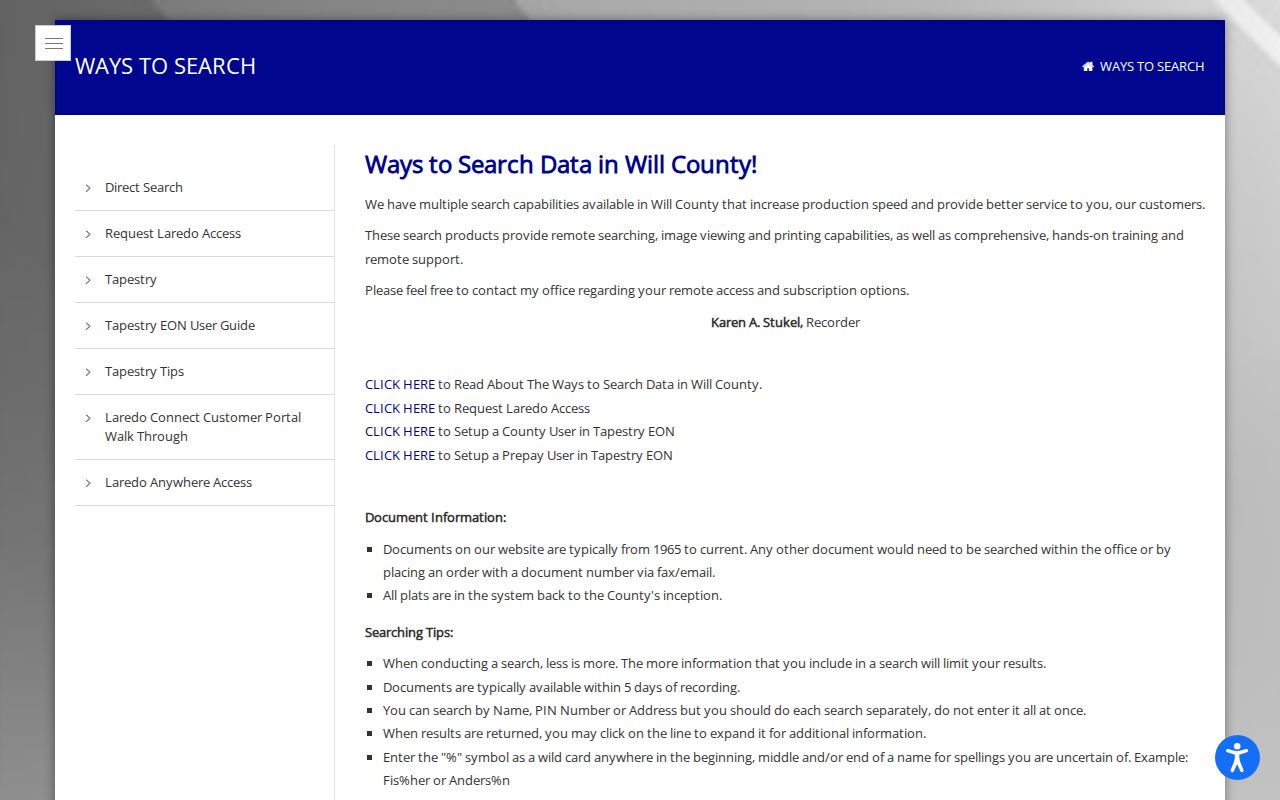
The guide makes the Will workflow distinct from DuPage. Keep a search log so the two county systems do not blend into one unsupported ownership story.
Pair Naperville Directories and Census
Deeds establish recorded interests, not all previous residents. A telephone book may list one subscriber. A city directory may name a householder, work role, spouse notation, or owner and renter mark, depending on the volume. A census schedule can list the household present on one enumeration date. Pairing these records is stronger than treating any one of them as a complete roster of previous residents.
- Choose the nearest directory year to a deed, permit, obituary, or known family event. Copy the entry as printed, including initials and abbreviations.
- Find the matching census year and correct enumeration district. Check the street, township, family order, relationships, ages, and birthplace fields.
- Compare adjacent directory years. A gap may reflect a missing volume, publisher change, moved subscriber, altered exchange, or street-number problem.
- Test the name and address against a deed, newspaper scan, cemetery entry, or permit. Record what each source actually proves.
The local Naperville city directory collections deserve their own shelf-level treatment. For a backward address trail, use only the years closest to the event. The Hollands business directory from 1886, the 1927-28 Smith directory, and the Haines/Criss-Cross entries recorded for 1983 and 1985 onward have different formats and purposes.
Naperville's 1932 Phone Clue
The digitized 1932 sample often called a directory is specifically a telephone subscriber page. It can show a surname, given name or initial, honorific, street address, telephone exchange, occupation, company, and marks such as r for residence or ofc for office. The inspected page does not show a full household roster or a consistent spouse field.
That distinction matters. A listed subscriber may be a business, doctor, dentist, office, or person from a nearby exchange. Aurora, Montgomery, North Aurora, Lisle, and rural entries can appear in the same book. Cite the page, year, creator, and notation, then seek a second dated record before naming previous residents.
The Library of Congress criss-cross directory guide explains the later address-first method used to work from a street number toward a listed subscriber.
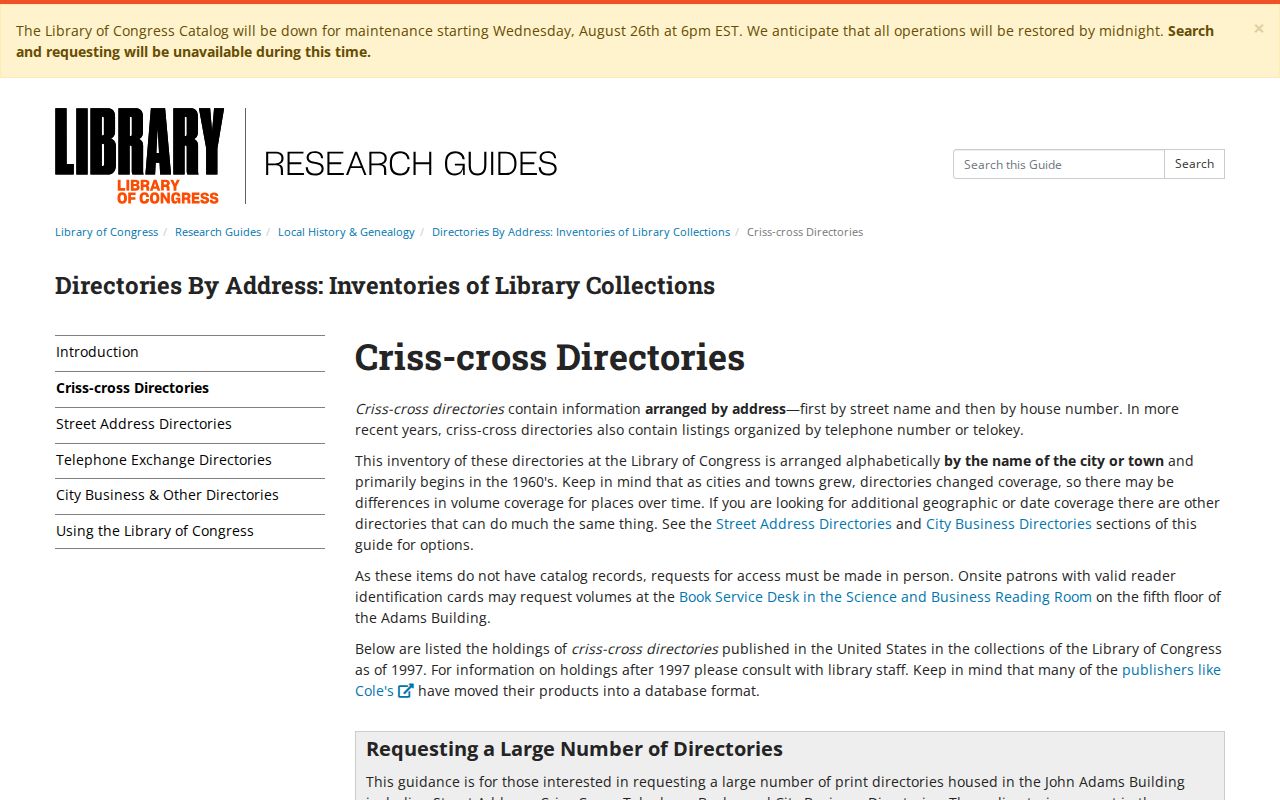
The method is valuable for past residents, but the local year and source type must remain attached to every result.
Map the Naperville House Era
Sanborn fire-insurance maps add a building history around the name trail. Digitized Naperville sheets exist for 1892 and 1921, while the local holdings inventory lists more years from 1886 through the 1926-49 run. The sheets can show a footprint, building use, construction material, additions, fire walls, hydrants, street width, and lot context. They do not identify each person inside.
City permit reports and Civic Access can date construction or a later change. Public permit fields may include number, status, location, dates, type, subdivision or lot, valuation, inspections, contacts, attachments, and sub-records. A contractor or applicant is a record role, not proof of residence. If a needed permit or code file is not exposed online, Naperville FOIA accepts online, email, and mail requests for an existing record.
Historic-district surveys give another Naperville layer. Local designation began in 1986 and covers about 320 properties; the federal district began in 1977 and was updated in 2012. Survey and nomination files may supply a building date, architect, prior owner, or historic context. They work best beside the deed chain and map, not in place of them.
Note: No official street-renumbering year was found, so resolve number conflicts through City GIS, plats, and legal descriptions.
Naper Records Fill Address Gaps
The Naper Settlement research collection holds several hundred local-history volumes and more than 14,000 photographs and images. Its research materials also include deeds and abstracts, maps and plats, newspapers from 1849 onward, census and cemetery material, family studies, city records, business ledgers, and municipal collections. An appointment is recommended, and the research library provides a curator contact for a focused request.
Ask for an original ledger, volume, photo, abstract, or map rather than a broad summary. Provide the parcel, street wording, family name, and date range. The library can also bridge a printed name to the Naperville Clarion, Naperville Sun, local church material, or a photograph. These items can explain why an owner vanishes from the online deed sequence or why a directory uses a different place label.
This is a strong human-use layer for family and house history. The archive preserves local context that a modern parcel card cannot hold, especially in the older river, rail, downtown, and college areas.
Naperville Household Trail Endpoints
When a name disappears, search a dated newspaper, obituary, cemetery index, probate docket, and later deed. The City cemetery ArcGIS layer supports queries by deceased name, cemetery, section, row, lot, sublot, and interment date. It is an interment index, not a death certificate. The DuPage or Will Circuit Clerk holds probate files, while county clerks and the Illinois Department of Public Health apply eligibility rules to vital copies.
An obituary may identify relatives, an earlier address, a church, or a probate lead. A probate file may identify an estate, fiduciary, or heir when those details are public. Cemetery and census records can close a family-history sequence, but neither should be turned into a claim about a living person's present location.
Lawful use. Naperville house-history work is suitable for genealogy, estate research, and personal curiosity. Do not use address records to track, threaten, harass, or harm anyone.
Research into previous residents is strongest when each conclusion rests on two dated sources. Keep the deed party, subscriber, taxpayer, and household roles distinct. That care preserves the useful story without adding facts the record never supplied.