
Naperville City Directory Runs
Naperville city directory research spans several kinds of books, not one unbroken series. A 1999 Illinois library inventory records concrete runs at the Naperville Public Library, while the library's current local-history staff can confirm what remains available and how it may be used. The oldest named directory in that inventory is Hollands' Business Directory of Naperville. Later sources include a regional Smith directory, Haines reverse books, and telephone books. Each source answers a different question, so record the title, publisher, date, and arrangement before treating an entry as evidence.
| Naperville collection | Years recorded | Where to ask | Access path |
|---|---|---|---|
| Hollands business directory | 1886 | Naperville Public Library | Verify current shelf or film status with staff |
| Smith regional directory | 1927-28 | Naperville Public Library | Inventory lead; request exact volume |
| Haines/Criss-Cross west suburbs | 1983 and 1985-current in the 1999 inventory | Library local history | Confirm present run before visiting |
| Naperville telephone books | 1931 and 1981-current in the inventory | Library and local collections | Print or microform availability varies |
| Heritage telephone collection | Most years, 1909-1960 | Illinois Digital Archives | Free online scans |
Do not read “current” in an older inventory as a promise about today's shelves. Ask for a year and publisher by name. Missing years may reflect a gap in the collection, a change of publisher, a rural listing, or a book that covered several west-suburban communities. A city directory result is strongest when its source identity remains attached to the transcription.
A missing year does not end the search. Ask staff whether a nearby volume, telephone book, newspaper index, church directory, yearbook, tax list, or manuscript collection covers the same household and period. Even one adjacent year can confirm a name, occupation, or address.
Naperville Library History Help
The Naperville Public Library genealogy and local history service is the practical first stop. It offers genealogy appointments, help from Fox Valley Genealogical Society volunteers, local digital collections, newspaper access, and library-card databases. Nichols Library is at 200 W. Jefferson, Naper Boulevard Library at 2035 S. Naper, and 95th Street Library at 3015 Cedar Glade. The main number is 630-961-4100.
Contact staff before a research trip. Give the surname, approximate year, address, and the exact book from the inventory when known. Ask whether the volume is name-first, street-first, on microfilm, or available as a scan. Staff guidance matters because a catalog entry is discovery data, not a person index. It can tell where a book sits without revealing whose names appear inside.
See the library local-history page as it appeared when the collection was reviewed.
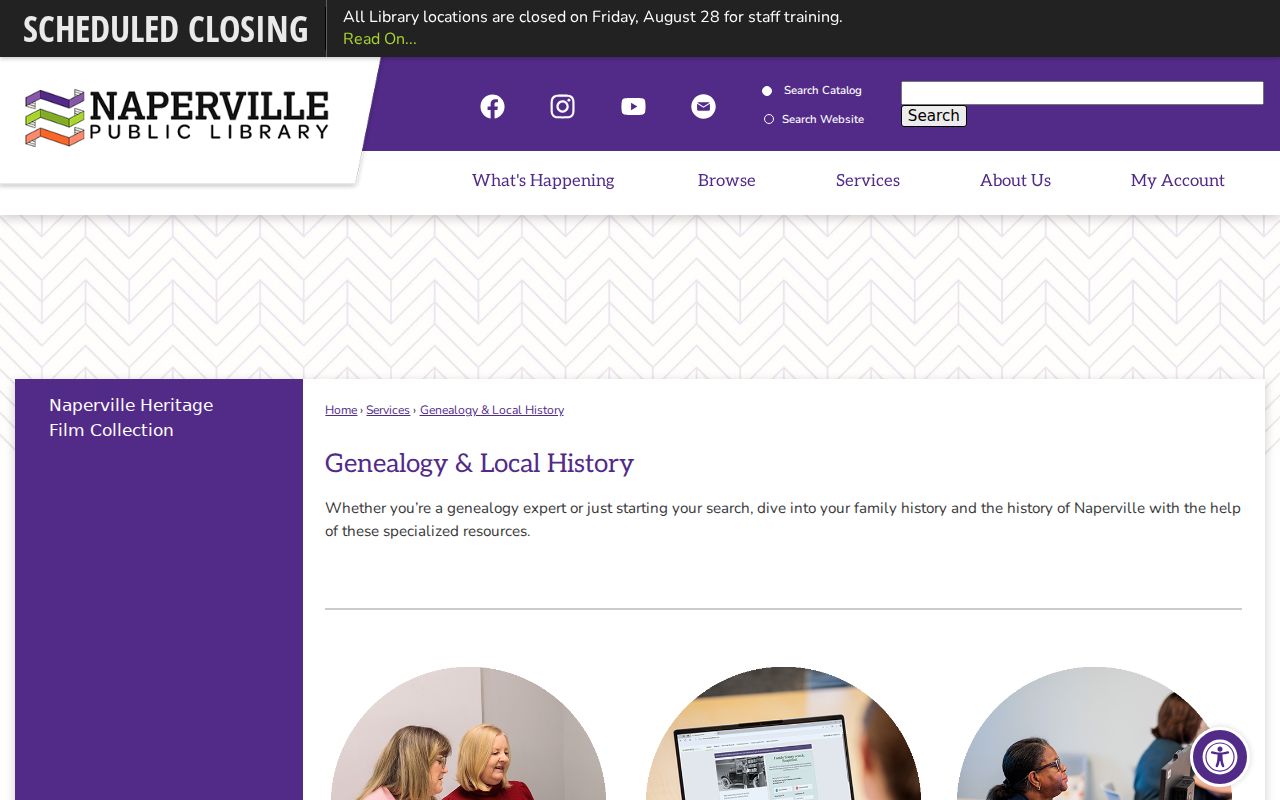
The image points back to the official research route, where appointments and present access details can be checked.
Digitized Naperville Directory Pages
The Naperville Heritage Collection in Illinois Digital Archives places much of the telephone-book run online. Its description covers most years from 1909 through 1960, as well as City Council minutes from 1857 through 1935 and local or church histories. Search the collection by title and date, then open the item viewer. A broad web search may miss names that are visible only on a scanned page.
The reviewed sample is Naperville Telephone Directory, August 1932, page 92. Illinois Bell Telephone Company is listed as creator, with the Chicago Reuben H. Donnelley Corporation as source. The scanned page is useful because it shows the real layout rather than a modern transcription.
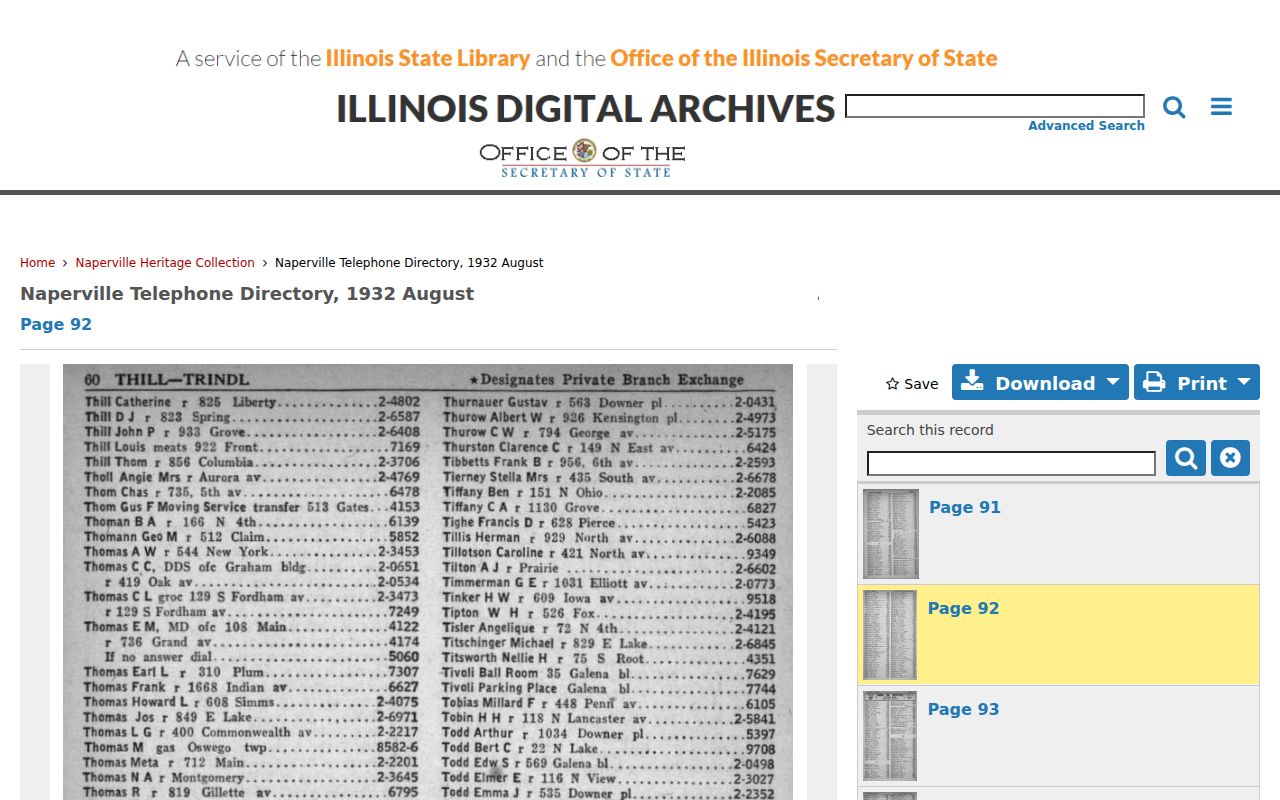
The scan makes clear that a telephone book is a subscriber list, not a full list of every person at an address.
Decode a Naperville City Directory
Read the title page and abbreviation key before copying a line. On the inspected 1932 page, entries may contain a surname, given name or initial, honorific, business or professional detail, street address, and telephone exchange. Marks such as “r” for residence, “ofc” for office, “MD,” and “DDS” appear. Neighboring places can share the same book, so an entry on the page is not automatically within Naperville's modern boundary.
| Identity | Surname, given name or initial, sometimes Mrs or Miss |
|---|---|
| Affiliation | Business, company, occupation, or professional suffix when supplied |
| Address | Street and number, rural route, township, or nearby community |
| Telephone | Historical exchange and number, sometimes a private branch exchange |
| Not present | No observed full household roster, spouse field, or owner/renter mark on the sample |
Other city directories may use different fields. Never import a spouse, ownership status, or complete household into a transcription unless that specific volume says so.
- Criss-cross directory
- A book arranged by street address or phone rather than surname.
- Householder index
- An address-oriented list of the person identified as the householder, not necessarily every resident.
- Abbreviation key
- The volume's own guide to short forms. Photograph or cite it with the entry.
Naperville Directory Research Library
Naper Settlement's Research Library broadens a city directory find into local history. Its holdings include hundreds of volumes on Naperville, DuPage County, and Illinois, plus maps, family studies, letters, photographs, newspapers, cemetery material, church records, census material, and city records. The related research collection describes more than 14,000 photographs and images, along with business ledgers, deeds, abstracts, maps, plats, scrapbooks, and municipal records.
Research is an appointment-based staff route, not a public browse-all name portal. Contact the Chief Curator at 630-420-6014 or McNultyC@naperville.il.us. The library is at 523 S. Webster Street. Bring the city directory citation and ask for records close to the same date. A photograph, ledger, plat, or newspaper notice can explain why a name appears beside a certain address.
Naperville Directory Time Markers
A short timeline helps choose the right companion record. Naperville was founded in 1831 and incorporated as a village in 1857. Directory and telephone-book evidence becomes much richer later, while census, maps, deeds, church records, and newspapers bridge earlier years.
| Year | Naperville research marker |
|---|---|
| 1886 | Hollands business directory and a listed Sanborn map year |
| 1909-1960 | Most telephone-directory years in the Heritage Collection |
| 1927-28 | Smith regional directory run |
| 1932 | Inspected Illinois Digital Archives telephone-book page |
| 1983, 1985 onward | Haines/Criss-Cross run recorded in the 1999 inventory |
These are source markers, not proof that every year survives. The 1999 inventory must be checked against current holdings.
Records Beside Naperville Directories
Newspapers can fill gaps between directory years. The inventory lists the Naperville Clarion for 1870-91 and 1897-1970, the Naperville Sun from 1935 onward, and other early local papers. The Illinois Digital Newspaper Collections can be searched by surname, address, group, event, or obituary date. Always open the scan because optical character recognition can distort names.
Census schedules through 1950 are public under the federal 72-year rule. Compare the closest schedule with the city directory entry, but account for township and boundary changes. Church registers, cemetery lots, funeral books, yearbooks, and family scrapbooks may identify people missed by a subscriber list. The DuPage County Genealogical Society township and cemetery index and IllinoisGenWeb are finding aids, not certified proof.
Maps Behind Naperville Directories
An address may stay recognizable while the building, lot, or city edge changes. The Library of Congress has digitized 1892 and 1921 Naperville Sanborn maps. The local inventory adds 1886, 1898, 1909, and 1926-49 microfilm. These sheets show building footprints, use, construction clues, fire walls, street width, and lot context. They generally do not name occupants.
Use the map only after reading its date and sheet key. Match the old street and lot to a plat or legal description if numbering does not line up. Naperville now crosses six townships and two counties, so a historic “Naperville” address may sit under a township or rural label in another source.
Trace Naperville Families by Directory
A careful family-history search preserves uncertainty. One absent entry can mean a move, death, unlisted phone, publication gap, spelling change, or a book that did not cover that part of Naperville. It does not prove the household vanished.
- Start with an exact name and address in the nearest known year. Save the title page and abbreviation key.
- Check the year before and after. Record spelling, initials, phone, work detail, and every address change.
- Use the reverse section, when present, to inspect the address rather than only the surname.
- Pair the result with the closest census, deed, map, newspaper, or cemetery record.
- Keep searching until two independent sources support the identity and place.
For a modern address-based trail, use the Naperville street directory rather than treating an old telephone listing as current. Historical work depends on dates, source labels, and corroboration.
Note: A subscriber entry supports a dated connection to a phone or address, but it does not prove a complete household.